Calendula Monograph
Calendula (Calendula officinalis), also known as pot marigold, has been treasured for centuries as a wound healer, immune support, and “herbal sunshine” for lifting the spirit. In this post, explore its botany, energetics, traditional and modern uses, scientific studies, and preparation methods—from teas and tinctures to salves and culinary recipes. Learn how Calendula supports skin health, digestion, and emotional balance, along with important safety considerations.
HERBAL MEDICINE
Annalisa Mazzarella, BCHN®, NBC-HWC
6/11/202212 min read
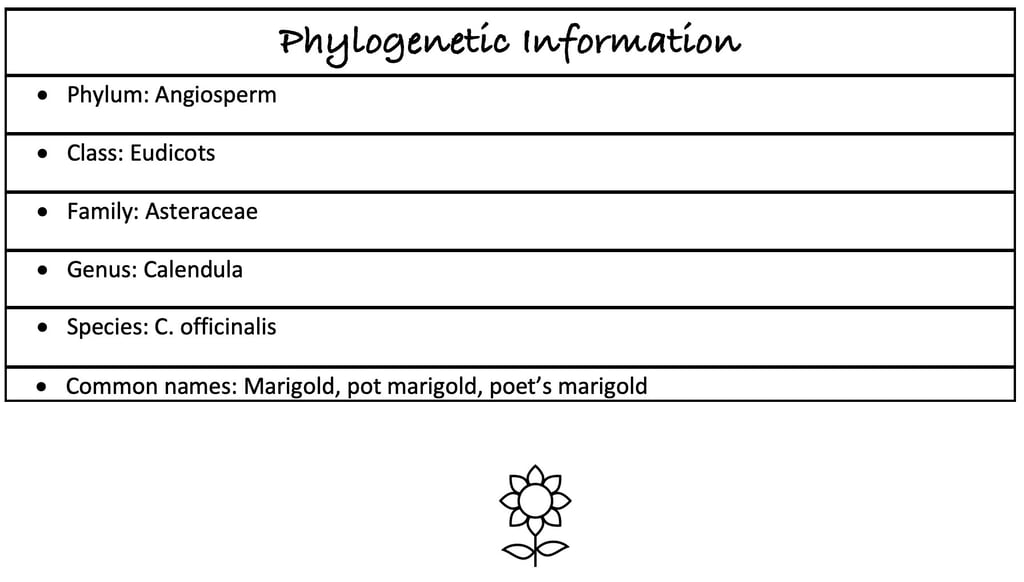
Botanical Information
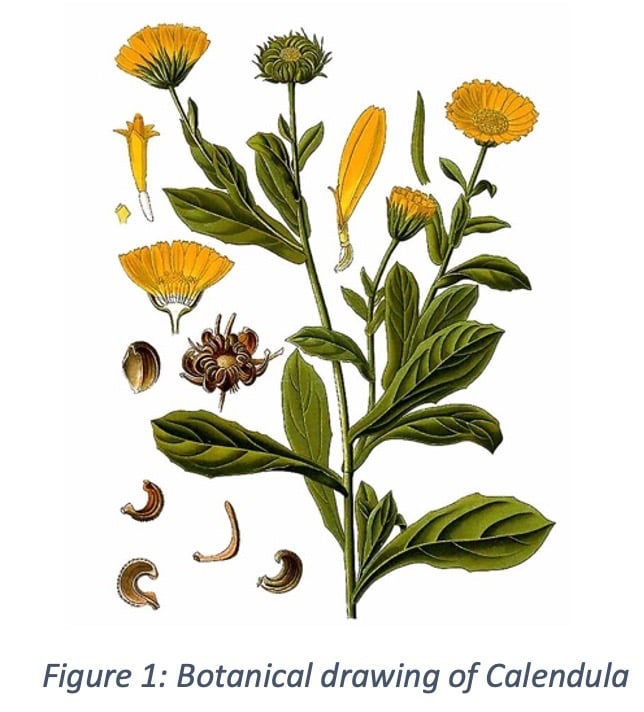
Calendula (Calendula officinalis) is a regular guest in my garden, cheering up winter dreary, cloudy days with her beautifully prolific orange and yellow blooms. I love planting Calendula year-round here in South Texas and letting it self-seed to attract pollinators and have a constant supply of sunshine-looking, pick-me-up, medicinally rich flowers to infuse honeys and oils, drink as tea, or just add to meals. Although its exact origins are unknown, Calendula is probably native to Southern Europe and North Africa with a centuries-old history of cultivation around the world. It is an herbaceous perennial, summer annual, or winter annual depending on the climate; grows up to 2 feet tall and continuously flowers throughout the growing season, loving a full sun exposure. Calendula has alternate leaves that are hairy and primarily oblanceolate (wider in the top half of the leaf) with entire margins. The flower heads may consist of multiple, overlapping ray florets (often referred to as “petals”) while the green involucre at the base of the flower head is highly resinous. [i]
[i] Juliet Blankespoor, “Calendula,” Chestnut School of Herbs, Herbal Immersion Program, 2017
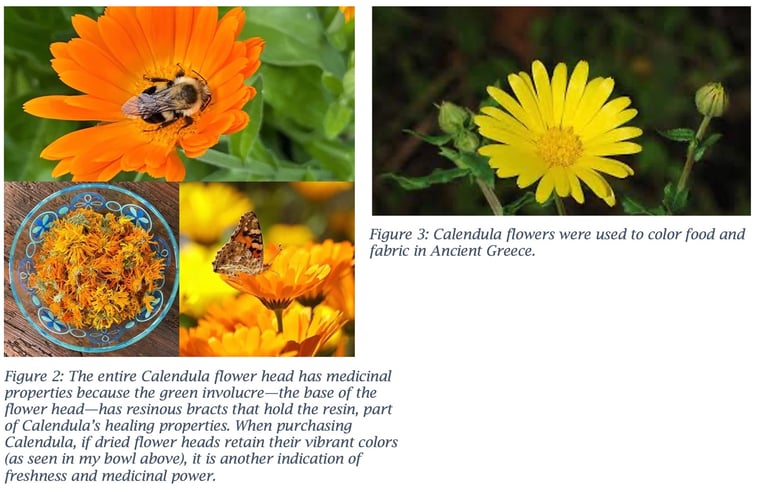
Look-alikes
Calendula is not to be confused with the common garden marigold of the genus Tagetes! These are garden ornamentals and not edible, with many overlapping petals and highly dissected leaves. Although the Tagetes marigold is in the same family as Calendula, it is not interchangeable. See the photos below for comparison. [i]
[i] Ibid
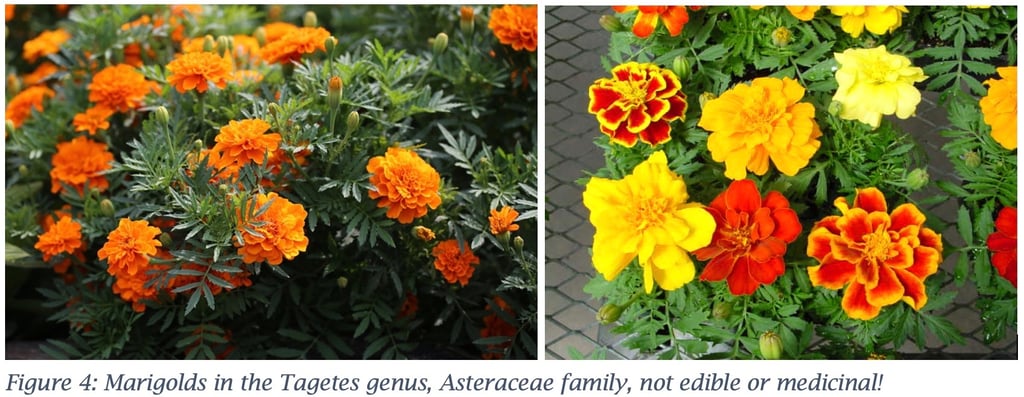
Herbal Information
Energetics: Warming, drying
Taste & smell: Pungent, slightly bitter, salty
Constituents: Large variety of biologically active substances such as terpenoids, flavonoids, saponins, carotenoids, volatile oils, quinones, phytosterols, resin, mucilage, polysaccharides, trace minerals, palmitic/malic/salicylic acid, and amino acids [i] [ii]
Herbal actions: Lymphagogue, immune-modulating, antifungal, antibacterial, antiviral, antioxidant, anti-inflammatory, anti-fibrotic, emmenagogue, hepatoprotective, cholagogue, choleretic, astringent, slightly demulcent, anti-cancer, antiseptic and vulnerary [iii]
Plant part used: Flower buds, leaves
Medicinal preparations: Tea, infused oil, poultice, compress, salve, tincture, vinegar, food, succus (juice), vaginal douches and suppositories, and sitz baths
Tincture ratios and dosage: Fresh flowers 1:2 95%; dried flowers 1:6 70%. Both preparations 2–3 ml (2/5 to 3/5 teaspoon) three times a day
Infusion ratios and dosage: 1 Tablespoon (15 ml) of the dried flowers infused in 1 cup (240 ml) of water three times a day; 3 to 12 grams of the dried flower a day by infusion [iv] [v]
Traditional and modern Uses…
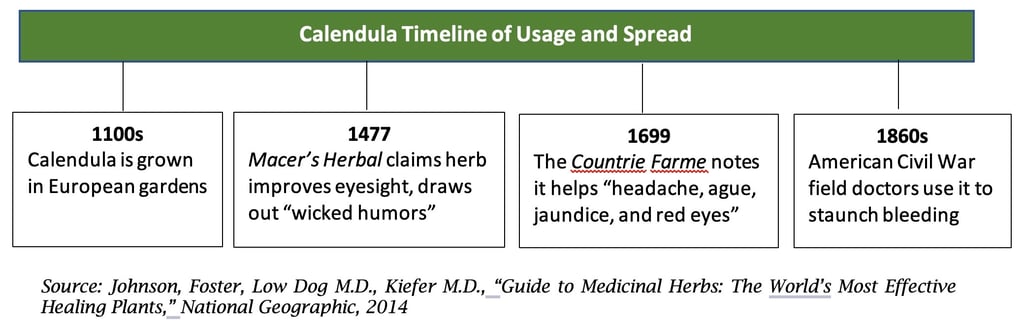
Calendula’s name derives from the Latin “calendae,” meaning “little calendar” or “little clock” or “throughout the months,” a possible reference to Calendula’s propensity for being in bloom for many months in some climates like South Texas. It has been cultivated for centuries across cultures to heal skin wounds, support the immune system, and boost the spirits. The flowers were used to decorate Hindu temples as it was considered one of the most sacred herbs in Ancient India, symbolizing thankfulness, excellence, and serenity. Calendula was also used to color food, cosmetics, and fabric in Ancient Greece, while the Romans used the flowers to make a soothing salve. In Medieval England, the edible petals were added to stews, syrups, and baked bread to comfort the heart and support the immune system. [vi] [vii] [viii] [ix]
The whole flower is loaded with triterpenes (calendulosides A-D), antioxidant compounds like carotenoids, flavonoids (isoquercitrin, narcissin, rutin), volatile oils and resins, chlorogenic acid, polysaccharides, and minerals (iodine- primarily found in the leaf). These phytochemicals are traditionally known for their anti-inflammatory and vulnerary (wound healing) properties in skin preparations, including burns, bruises, boils, rashes, ulcers, and lesions—especially those difficult to heal; however, this herb has many more “super-powers,” including digestive properties, immune building qualities, and emotional support to overcome sorrow—especially when combined with lavender and rose. Herbalist Chris Heifer describes Calendula as “herbal sunshine,” cleansing “cold/depression and dampness from the tissues and organs, but also from the mind, gently but effectively lifting up our consciousness, shining the light into those darkened recesses of the Self, and clarifying the senses.” [x] [xi] [xii] [xiii] [xiv]
In Traditional Chinese Medicine, Calendula is used to clear toxic and damp heat; reduce infection, inflammation, swelling, and fevers; stimulate immunity; reduce lymph and liver congestion and decrease lipids. As it vitalizes the blood, it is also used to regulate menstruation, to balance hormones, to stop bleeding, and reduce tumors. Calendula tonifies heart Qi, promotes tissue repair, prevents decay, and benefits the skin.[xv]
[i] Dr. Sharol M. Tilgner, “Herbal ABCs – The Foundation of Hrbal Medicine,” 2018
[ii] Peter Holmes, “The Energetics of Western Herbs – A Materia Medica Integrating Western and Chinese Herbal Therapeutic,” Vol. 2, 2006
[iii] Idid
[iv] Juliet Blankespoor, “Calendula,” Chestnut School of Herbs, Herbal Immersion Program, 2017
[v] Rosalee de la Floret, “Calendula Monograph,” https://herbmentor.learningherbs.com/herb/calendula/
[vi] Culpeper, N. The Complete Herbal; to Which Is Now Added, Upwards of One Hundred Additional Herbs, with a Display of Their Medicinal and Occult Qualities Physically Applied To the Cure of All Disorders Incident to Makind . (Thomas Kelly & Company, 1863).
[vii] Grieve, M., and Leyel, H. A Modern Herbal: The Medicinal, Culinary, Cosmetic and Economic Properties, Cultivation and Folk-Lore of Herbs Grasses, Fungi, Shrubs & Trees with All Their Modern Scientific Uses (Hafner Press, 1974).
[viii] Rebecca L. Johnson, Steve Foster, Tieraona Low Dog M.D., & David Kiefer M.D., “36 Healing Herbs: The World Best Medicinal Plants,” (National Geographic, 2012)
[ix] http://www.apinchof.com/calendula1120.html
[x] McIntyre, A. The Complete Herbal Tutor: The Ideal Companion for Study and Practice (Octopus Books, 2010).
[xi] Juliet Blankespoor, “Calendula,” Chestnut School of Herbs, Herbal Immersion Program, 2017
[xii] Herbal Medicine: Expanded Commission E Monographs, http://cms.herbalgram.org/expandedE/Calendulaflower.html
[xiii] The School of Evolutionary Herbalism, “Issue One: Calendula,” Materia Medica Monthly
[xiv] Dr. Sharol M. Tilgner, “Herbal ABCs – The Foundation of Herbal Medicine,” 2018
[xv] Peter Holmes, “The Energetics of Western Herbs – A Materia Medica Integrating Western and Chinese Herbal Therapeutic,” Vol. 2, 2006
On the Spiritual Side…
In biblical times, Calendula’s bright yellow flowers were considered a symbol of “the son of righteousness driving away the sins of darkness.” It was also known as Mary’s Gold and believed to be blooming “in the Holy Land on each of her holy days and festivals,” placing the flowers by the Virgin Mary’s statues. Legend says the biblical Mary wore them on her dress. Monks in the 1400s planted Calendula flowers in their “Mary’s gardens” and to these days it is usually included in “Biblical gardens.” [i] [ii]
According to the Energetic Architecture model, every plant has a ruling Planet, Element, and Principle.
Ruling Planet: the Sun. Calendula blooms look like the sun with their bright yellow and orange flowers and “represent the solar cycle and the life it brings to Earth.” At one time, it was also known as “Sponsa Solis,” which means spouse of the sun. Her medicinal powers are solar as well, warming, thinning fluids, and relieving stagnation at the physical and spiritual level—boosting vitality and immunity. The Sun also represents the gravitational center of our solar system, and hence “the gravitational center of our psyche,” which translates into Calendula’s dissipating “the clouds of doubt, uncertainty and depression” and fostering a connection to your true Self.
Ruling Element: Water. Calendula works by dispersing the Waters of the body, supporting the lymphatic system. Its mucilaginous polysaccharides are soothing to the mucosal membranes.
Ruling Principle: Sulfur. In the Western alchemical tradition, Calendula “yields a significant amount of highly aromatic, resinous fixed Sulfur as compared to its yields of Mercury and Salt…and it is pungent, warming, activating, dispersing, and stimulating in its qualities.” [iii]
[i] https://www.stpaullutheranph.com/uploads/2/8/4/3/28431489/feature_article_biblical_herb_garden.pdf
[ii] https://www.angelfire.com/journal2/flowers/c.html
[iii] The School of Evolutionary Herbalism, “Issue One: Calendula,” Materia Medica Monthly
Scientific Studies
While there is a long and documented history of Calendula being used for its medicinal properties among herbalists and across cultures throughout centuries, this flower has also caught the attention of the scientific world. The German Federal Institute for Drugs and Medical Devices Commission E[1] has actually approved Calendula for treating wounds based on its anti-inflammatory effects and antioxidant properties.[1]
Comparative Studies’ Review
A 2019 comparative study reviewed the findings of 7 animal experiments and 7 clinical trials evaluating the role of Calendula officinalis flower ethanolic extract—administered orally or topically—as “monotherapy compared to control for wound healing in vivo.” Results differed whether the treatment focused on acute or chronic wound healing. For instance, across 5 animal studies and 1 randomized clinical trial, a Calendula extract treatment showed a “faster resolution of the inflammation phase with increased production of granulation tissue” in the test groups’ acute wounds.
Chronic wound healing studies, however, had mixed results, with 2 clinical control studies on venous ulcers demonstrating faster surface area healing compared to controls, while another randomized clinical trial focused on diabetic leg ulcers healing showed no improvement for the calendula group. Similar mixed results were obtained when treating burns. A randomized clinical trial of patients with “partial to full thickness burns” demonstrated no benefit for a Calendula extract’s topical application compared to controls; another randomized clinical trial assessing the extract’s potential prevention of “acute post radiation dermatitis” showed improvements compared to trolamine, while a second study found no improvement compared to aqua gel cream. [2]
However, it is important to remember there are very few studies that have assessed Calendula’s chronic wound healing properties with several methodological limitations in the study designs, including small sample sizes, proper dosage, and consistent type of extract. Therefore, additional randomized studies are needed to document Calendula’s beneficial effect on such wounds. But let’s take a closer look at a few control studies that examined Calendula’s anti-inflammatory, vulnerary, and antioxidant properties.
In-Vivo Control Studies
Anti-inflammatory and Vulnerary Properties
In a 2005 study, researchers studied the therapeutic efficacy of a Calendula officinalis extract on the epithelialization of lower leg venous ulcers in 34 patients who were divided in 2 groups. The first contained 21 patients who had 33 venous ulcers and were treated with a Calendula extract prepared in a Soxhlet apparatus[2] twice a day for 3 weeks. The second group was a control group with 13 patients suffering from 22 venous ulcers who applied saline solution dressings to ulcers for 3 weeks. In the experimental group, after 3 weeks, the total surface of all the ulcers decreased by 41.7% and 7 patients achieved complete epithelialization. In the control group, the total surface of all the ulcers decreased by only 14.5% and 4 patients achieved complete epithelialization. Overall, the study showed a statistically significant acceleration of wound healing in the experimental group.[3]
In a 2009 study, researchers found the ethanolic extract of Calendula officinalis possessed significant anti-inflammatory activity against carrageenan and dextran–induced paw edema in mice. The oral administration of 250 and 500 mg/kg body weight of Calendula officinalis extract significantly reduced inflammation (50.6% and 65.9% respectively) in mice’s paw edema induced by carrageenan and 42.9% and 42.4% respectively produced by dextran. Researchers also found that when chronic inflammation was induced with formalin, oral administration of 250 and 500mg/kg body weight calendula extract produced an inflammatory inhibition of 32.9% and 62.3% respectively compared to controls.[4]
In a 2011 study, researchers tested the angiogenic activity of Calendula officinalis ethanolic extract on 36 rats through the induction of skin wounds. Digital planimetry by point counting performed on mice derma treated with 1% ethanolic extract revealed a statistically significant increase in the number of blood vessels and a reduction of total wound area compared to the solvent control group, showing an overall decrease of 41.71% in the experimental group compared to 14.52% in the control group. The study concluded the application of Calendula extract significantly increases the epithelization in chronic venous ulcerations in rats.[5]
While the last 2 studies did not involve humans, their results are very encouraging because they show Calendula has significant anti-inflammatory and vulnerary properties on animals, further enriching our knowledge base.
· Antioxidant Properties
A 2006 study evaluated an alcoholic extract of Calendula officinalis for its antioxidant properties by administering it to 32 female Swiss albino mice, which were divided into four groups of 8 animals and were treated orally with the extract at different doses—control, 50 mg/kg body weight, 100 mg/kg, 250 mg/kg—for 30 days. Calendula flowers (700 g) were extracted with 450 mL of ethyl alcohol. 100 milliliters of this tincture was evaporated to dryness in a shaker water bath at 42°C, and 1 gram of the dried extract was redissolved in a known amount of distilled water and used for all experiments. Data collected from the animals showed the extract inhibited superoxide generation in macrophages by 12.6% and 38.7% at doses of 100 and 250 mg/kg body weight, respectively. The extract also produced a significant increase in glutathione levels in the blood and liver.[6]
A 2013 study was conducted to evaluate the phenolic content, the antioxidant properties, and the hepatorenoprotective potential of Calendula officinalis extract against aflatoxins (AFs) induced liver damage. 60 three-month-old male Sprague Dawley rats were divided into 10 groups. They were treated daily for 6 weeks and included the control, the group fed AFs-contaminated diet (2.5 mg/kg diet), the 2 groups treated orally with 500 mg/kg body weight (CA1) and 1000 mg/kg body weight (CA2) doses of Calendula extract respectively, and the 2 groups pretreated orally with Calendula extract at the two tested doses one week before and during AFs treatment for another five weeks.
After the treatment period, all rats were fasted for 12 hours, and blood samples were collected for analysis. The results showed the animals fed an AFs-contaminated diet had a significant increase in inflammation as well as much higher levels of malondialdehyde (MDA) with a significant decrease in superoxide dismutase (SOD) and glutathione peroxidase (GPx) in the liver. However, the groups treated orally with CA1 and CA2 one week before and during AF treatment showed statistically significant improvement in their biochemical parameters and inflammatory cytokines, with oxidative stress and improved liver histological pictures. Therefore, researchers concluded “Calendula extract has potential hepatoprotective effects against AFs due to its antioxidant properties and radical scavenging activity.” [7]
Even though these studies were performed on rats, the results are again very encouraging because they show how the alcohol-based extract of Calendula has significant antioxidant effects in animals and warrant further study.
Recipes
Holmes recommends a low alcohol extraction (1:3 at 25% ethanol) to favor the flavonoids but prefers a high alcohol extraction (1:3 at 90% ethanol) for anti-bacterial, anti-microbial, and anti-fungal applications. In both cases, dosage should be 2-4 ml. For topical use, Calendula combines well with Arnica (Arnica montana) flowers, St. John’s Wort (Hypericum perforatum), Witch Hazel (Hamamelis virginiana), and Plantain (Plantago major). In feverish “wind-heat onset of infections with swollen glands,” Holmes recommends a hot infusion with other detoxicant diaphoretics such as Yarrow (Achillea millefolium), Elder (Sambucus nigra), and Chamomile (Matricaria recutita) flowers.
The Chestnut School of Herbal Medicine recommends using Calendula to make:
a concentrated tea from the flowers along with garden Sage (Salvia officinalis) and Yarrow (Achillea millefolium) for bacterial vaginosis, yeast infections, and cervical dysplasia, as well as healing perineal tears and abrasions after childbirth.
a salve with Plantain (Plantago spp.), Chickweed (Stellaria media), Saint John’s wort (Hypericum perforatum), and Violet (Viola sororia and others) for skin lesions, including chickenpox.
a tea combined with Licorice (Glycyrrhiza glabra), Slippery elm (Ulmus rubrum), and Meadowsweet (Filipendula ulmaria) for the treatment of GERD.
I love to combine Calendula with Lavender (Lavandula angustifolia), Lemon balm (Melissa officinalis), and Rose (Rosa spp.) as a pick-me-up winter tea or combine it with Bee balm (Monarda didyma), Holy basil (Ocimum tenuiflorum), Gotu kola (Centella asiatica), or Echinacea (E. purpurea) to strengthen my immune system. If you enjoy baking, try adding calendula and violets’ petals to muffins or corn bread! [8] [9]
Precautions and Contraindications
The Herbal Medicine: Expanded Commission E Monographs do not list any restrictions for use during pregnancy and lactation. However, several sources do not recommend ingesting Calendula during pregnancy. As calendula is in the Aster family, it may cause a reaction in people who are highly sensitive to plants like ragweed and chamomile. Rare incidences of allergic contact dermatitis have occurred with the topical use of Calendula.[10]
References:
[1] A committee made up of scientists, toxicologists, doctors, and pharmacists formed by the German government in 1978 to find out if herbs sold in Germany are safe and effective. The Commission has published information on the uses, side effects, and drug interactions of more than 300 herbs.
[2] The Soxhlet extraction is an automatic continuous extraction method with high extraction efficiency that requires less time and solvent consumption than maceration or percolation
[1] Herbal Medicine: Expanded Commission E Monographs, http://cms.herbalgram.org/expandedE/Calendulaflower.html
[2] Givol O, Kornhaber R, Visentin D, Cleary M, Haik J, Harats M., “A systematic review of Calendula officinalis extract for wound healing,” Wound Repair Regen. 2019 Sep;27(5):548-561. doi: 10.1111/wrr.12737. Epub 2019 Jun 20.PMID: 31145533, https://sci-hub.se/10.1111/wrr.12737
[3] Duran, V, M Matic, M Jovanovć, N Mimica, Z Gajinov, M Poljacki, and P Boza. "Results of the Clinical Examination of An Ointment with Marigold (Calendula Officinalis) Extract in the Treatment of Venous Leg Ulcers." International journal of tissue reactions 27, no. 3 (2005): 101-6
[4] Preethi KC, Kuttan G, Kuttan R. Anti-inflammatory activity of flower extract of Calendula officinalis Linn and its possible mechanism of action. Indian J Exp Biol. 2009;47(2):113–120.
[5] Parente LML, Andrade MA, Brito AB, et al. Angiogenic activity of Calendula officinalis flowers L. in rats. Acta Cir Bras. 2011;26(1):19–26.
[6] Preethi KC, Kuttan G, Kuttan R., Antioxidant potential of an extract of Calendula officinalis flowers in vitro and in vivo. Pharmaceutical Biology. 2006;44(9):691–697.
[7] Mohamed A. Hamzawy, Ezzeldein S. M. El-Denshary, Nabila S. Hassan, Fathia A. Mannaa, and Mosaad A. Abdel-Wahhab, Dietary Supplementation of Calendula officinalis Counteracts the Oxidative Stress and Liver Damage Resulted from Aflatoxin, ISRN Nutr. 2013; 2013: 538427, Published online 2013 Feb 12. doi: 10.5402/2013/538427
[8] Peter Holmes, “The Energetics of Western Herbs – A Materia Medica Integrating Western and Chinese Herbal Therapeutic,” Vol. 2, 2006
[9] Juliet Blankespoor, “Calendula,” Chestnut School of Herbs, Herbal Immersion Program, 2017
[10] AHPA, “Botanical Safety Handbook,” 2nd Edition, 2019
"If you truly love nature, you will find beauty everywhere"— Vincent Van Gogh
Contact us:
info@wildwoodsherbals.com
© 2025. All rights reserved.
My post content


